The Year without a Summer
On the 10 April 1815, Indonesia’s Mount Tambora (Gunung Tambora) erupted, killing thousands of people in the immediate vicinity. The volcano had been dormant for centuries, but small tremors began to be felt from the 5 April. The eruption is the largest in recorded history and sent up millions of tons of ash, pumice and sulphur into the atmosphere, blocking out the sun.
These fine particles were carried around the globe, obscuring the sun and cooling the air. The effects felt around the world were devastating and long-lasting; the 1810s would be one of the coldest decades ever recorded. Global temperatures cooled by as much as 3 °C (5.4 °F), leading to years of famine and disease, civil unrest, poverty and even migration as people tried to cope with rising costs and lack of food. Indeed, 1816 would become known as the ‘year without a summer’ as Western Europe and the eastern parts of North America struggled to cope with devastating frost and heavy snow throughout June, July and August, leading to more crop failures and starvation.
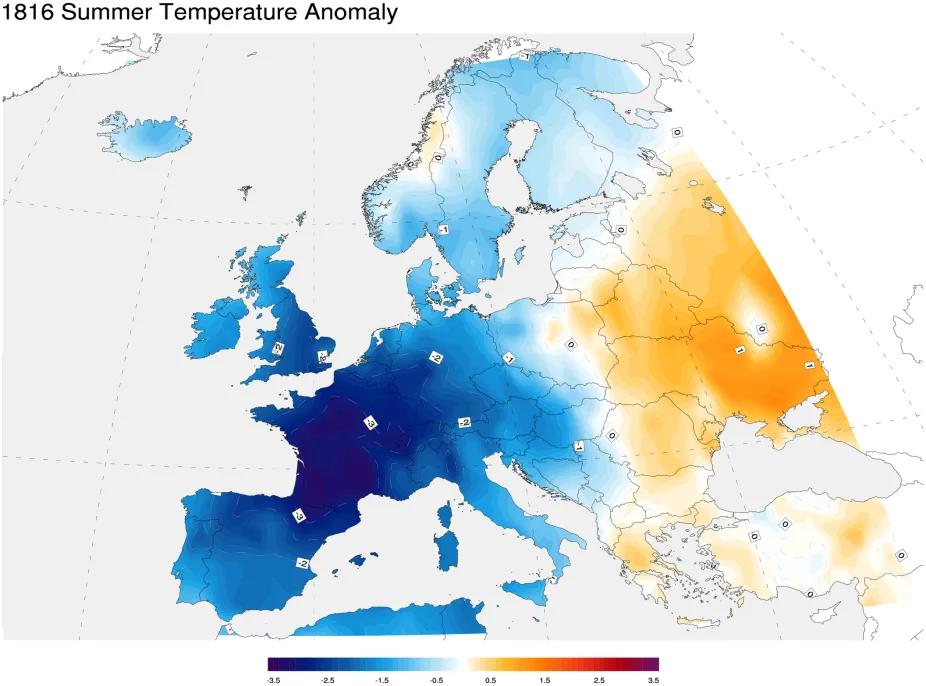
Map of unusual cold temperatures in Europe during the summer of 1816. Temperature anomalies are in degrees Celsius (°C) with respect to 1971-2000 climate normals; Creative Commons, authored by Giorgiogp2; See this .
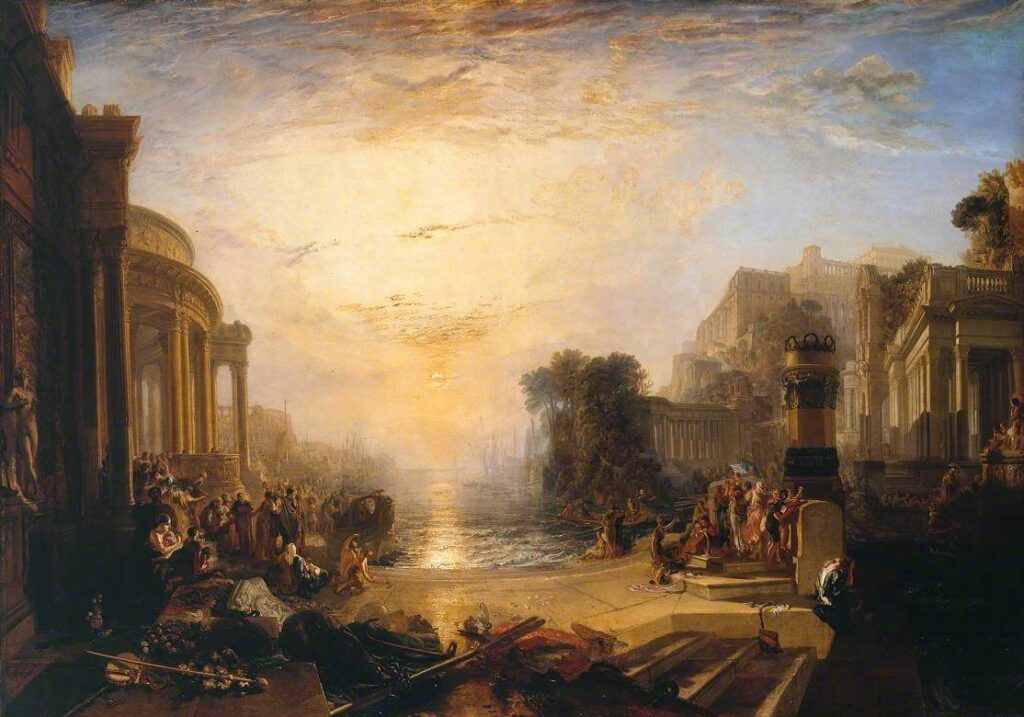
But despite these extreme environmental changes, 1816 produced an abundance of innovative art, music and literature (and also the bicycle). In an age of (literal) darkness, light, warmth and fire seemed to ignite (sorry) the poetic imagination. Goethe, Beethoven, Schubert, Byron and Shelley penned poems and wrote music celebrating Prometheus, the rebel Titan god, who dared to give humans fire and with it, the ability to innovate and create art. The changes in the atmosphere had a significant impact on the ways visual artists such as Caspar David Friedrich and J.M.W. Turner attempted to capture the light, particularly at the start and end of day. Indeed, scientists working at the Academy of Athens are even leveraging these paintings in their studies to help them calculate the levels of volcanic aerosols in the atmosphere in the aftermath of the eruption.
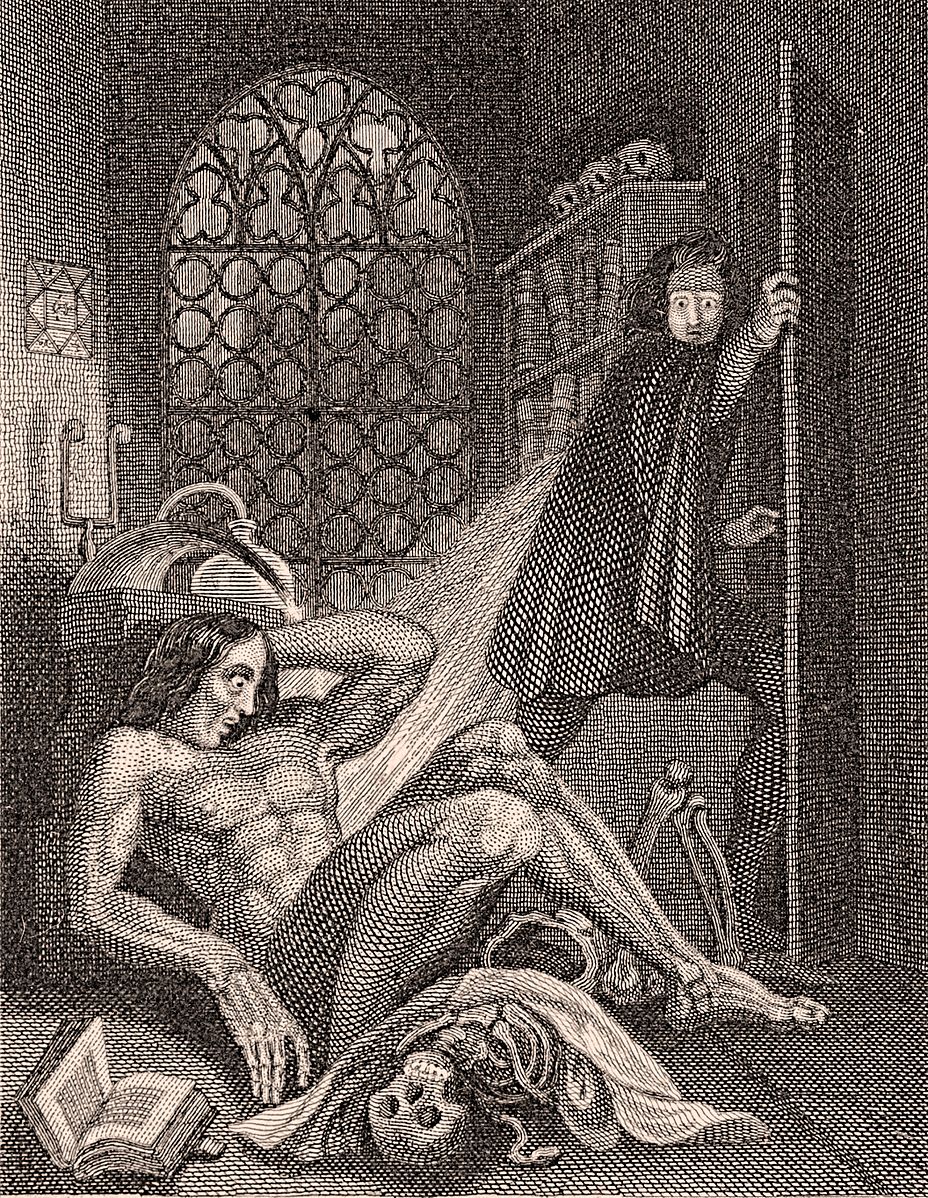
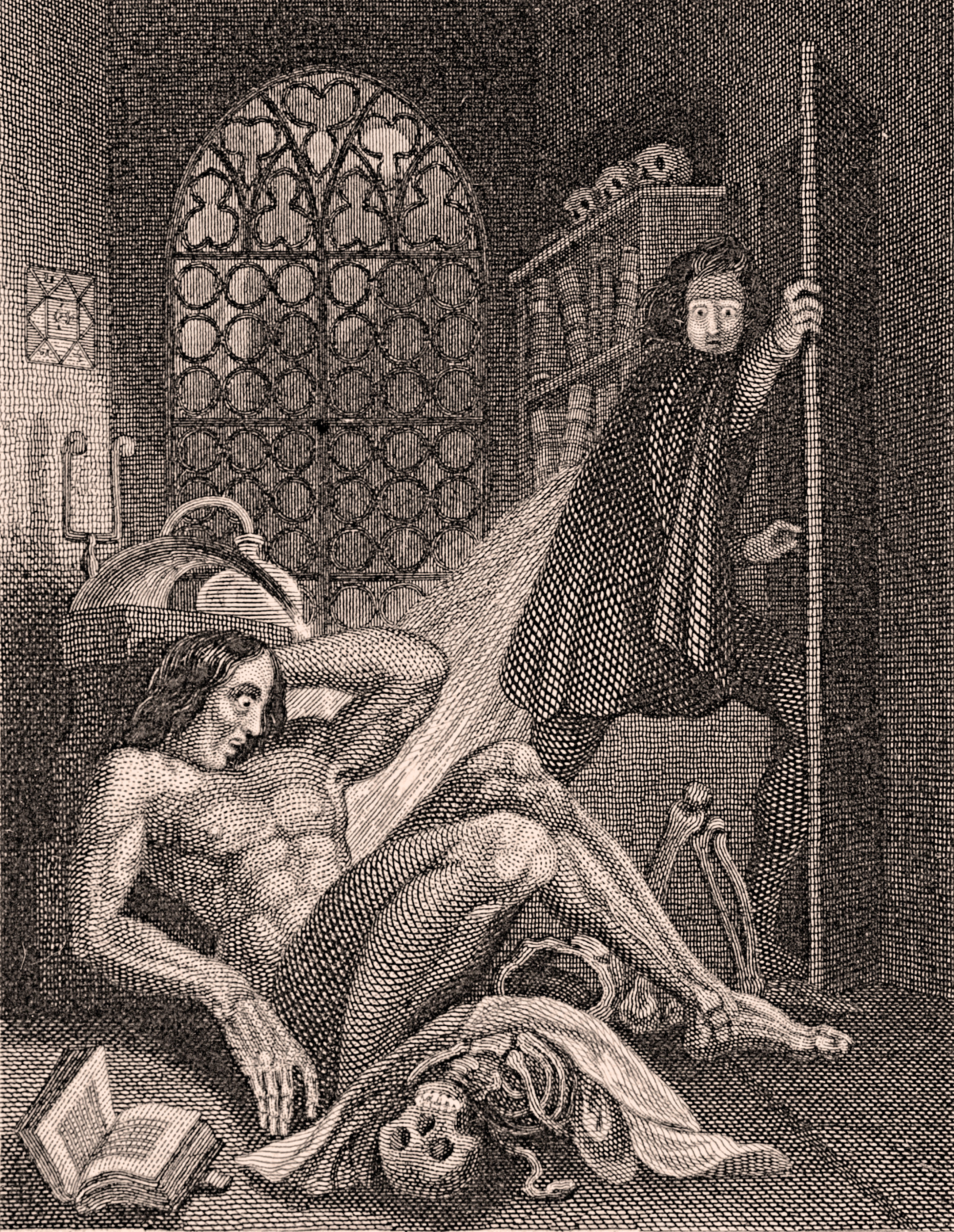
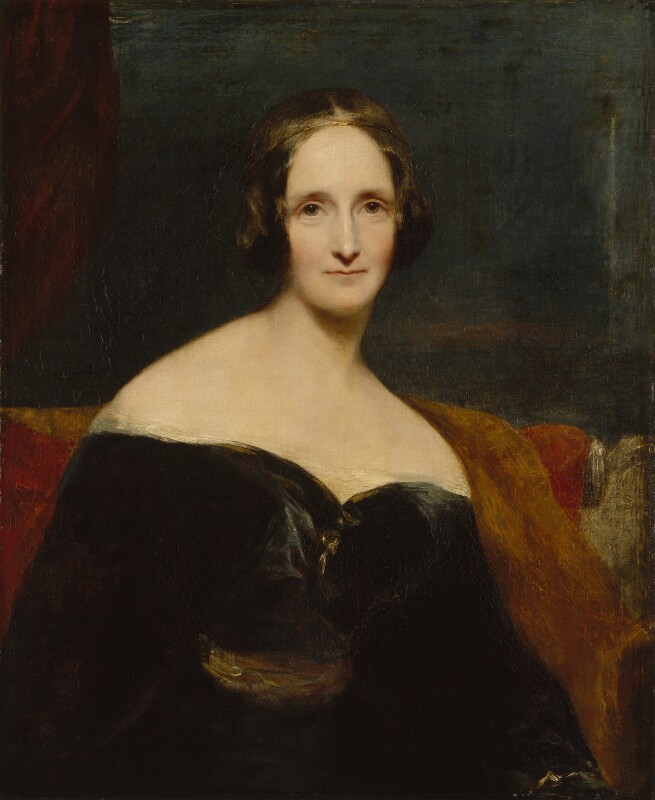
Perhaps the single most important work to come out of the summer-less year of 1816 (to my mind at least) was Mary Wollstonecraft Shelley’s Frankenstein, or the Modern Prometheus. In the early summer of 1816, Mary Wollstonecraft Godwin, her then-lover, later husband Percy Bysshe Shelley and her sister Claire Clairmont travelled to Switzerland to meet Lord Byron, who was staying, along with his physician John Polidori, in the Villa Diodati on Lake Geneva. Torrential downpours prohibited them from venturing outdoors, so, sans Netflix, they turned to reading, and then to writing, ghost stories. Though she struggled at first, Mary was the only one to complete the task (though Polidori would later rework Byron’s draft tale into The Vampyre). The novel was published anonymously in 1818, with many assuming it had been written by Percy. In the 1831 edition she recounts the now infamous summer, writing,
‘I busied myself to think of a story, —a story to rival those which had excited us to this task. One which would speak to the mysterious fears of our nature, and awaken thrilling horror—one to make the reader dread to look round, to curdle the blood, and quicken the beatings of the heart’.
She clearly succeeded in this task. Influenced by the scientific experiments and lectures she had attended in London, as well as the group’s ongoing discussions about natural philosophy (or what would come to be known as ‘science’), and tempered by the environmental and social ramifications of the previous year’s volcanic eruption, Mary Wollstonecraft Shelley wrote one of the most groundbreaking and influential novels ever produced, one which has sparked countless interpretations, retellings and adaptations in film, theatre, art and literature. Not bad for a nineteen year old girl.
FURTHER READING:
If you’d like to learn more about the environmental, social and cultural impacts of Mount Tambora’s eruption (and its potential future activity) you might find the following helpful:
https://www.thoughtco.com/the-year-without-a-summer-1773771
https://www.economist.com/briefing/2015/04/11/after-tambora
https://scied.ucar.edu/learning-zone/how-climate-works/mount-tambora-and-year-without-summer
For an online copy of the 1831 edition of Frankenstein, click here.
The British Library also has this lovely short article on the novel:
If you’d like to know a bit more about Mary Wollstonecraft Shelley, this article may be of interest.
Lord Byron also wrote his poem Darkness in response to these events.